EVA has been an event industry trailblazer since its co-founders, Makenzie Stokel and Channing Moreland, launched the platform from their college dorm at Nashville’s Belmont University. At its core, EVA is all about simplifying how corporate groups find entertainers, speakers and other performers for events. But beneath the surface, EVA also seeks to ensure that entertainers book gigs on a more consistent basis—and are paid in a timely manner—while encouraging corporate groups to look beyond celebs and tap into local talent.
Belmont “was a music school, so we saw a lot of really good musicians, songwriters and upcoming artists willing to play for free for exposure,” Stokel recalled of EVA’s earliest days, circa 2013. “We were like, ‘You’re never going to make money that way.’ So we would help them in a business sense with pricing, and then help them get bookings.” EVA was incorporated by 2015 and really took off come 2019, quickly garnering massive corporate clients like Amazon, BMW, ESPN and LinkedIn, to name a few.
How it works: entertainers and event planners can make accounts on EVA’s platform. Entertainers create profiles with their portfolio, testimonials, and pricing details. Planners can then submit inquiries with different entertainers and, when it’s time to book, EVA facilitates the transaction using a standardized contract and in-house payment processing platform. It also provides both parties with event insurance.
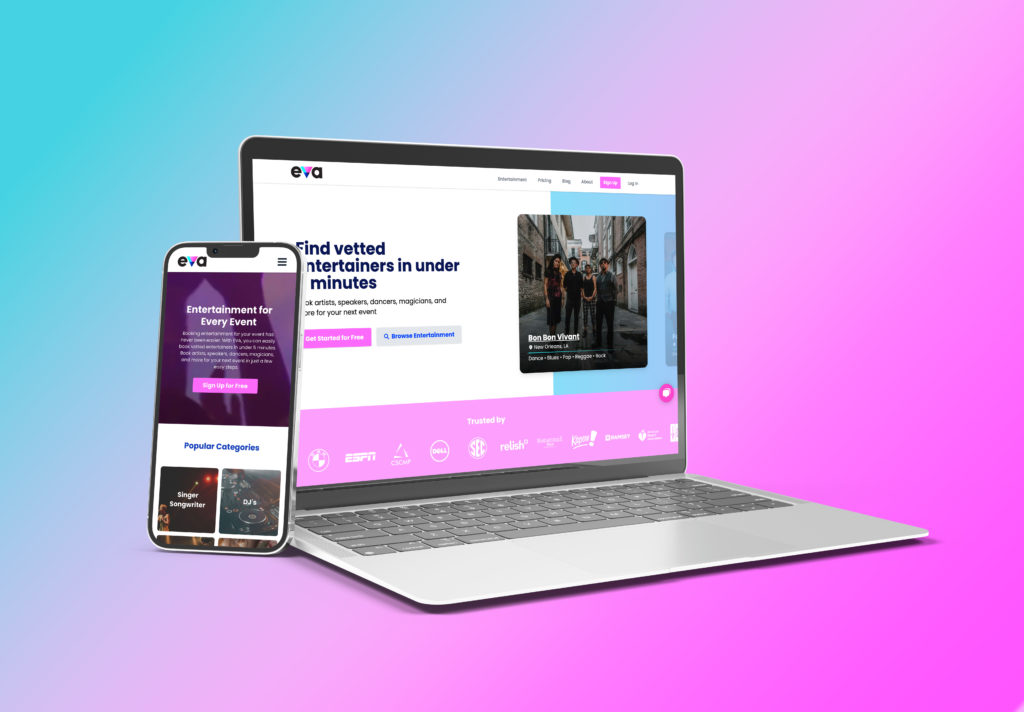
It’s free to make an account on the platform, but EVA takes a percentage from the entertainer and charges planners a 22% “Platform Service Fee” on all booked events.
The industry’s need for a platform like EVA’s is evident in its rapid growth (it went from supporting 70 to more than 3,000 performers since the pandemic) as well as its recent accolades. EVA has already found itself in headlines on TechCrunch and Forbes, and won BizBash’s “Best New Event Product/Service” award at its latest Event Experience Awards ceremony. Perhaps most impressively, it also secured $2 million in funding that values the company at $15 million late last year.
EVA’s first order of business after the latest funding round, during which it garnered more than double the amount it was seeking, was launching its entertainment-booking services in New York City (it already operates in seven other markets: Atlanta, Austin, Dallas, Chicago, Charlotte, Nashville and New Orleans). It marked the occasion with a swanky to-do at Sixty LES Hotel’s Make Believe rooftop featuring performances by real entertainers on EVA.
The next step will be a rollout in Los Angeles, though that’s been paused in the wake of devastating wildfires. There’s currently no “set launch date” in mind, Stokel said, noting that EVA’s not interested in “pushing ourselves where it’s too early or inappropriate.” Rather, EVA is waiting to see when the time is right—a skill Stokel and Moreland have honed in on.
When asked about how EVA has achieved such success so quickly, the co-founding team attributed it all to one key trait: patience.
“When Makenzie and I were still in college, we had been approached to quit school and take on a big round of multimillions,” Moreland told Vendelux. “We ended up turning that down because we knew as college kids, we would’ve spent that in all the wrong places.” Meanwhile, competitors were raising $5 million per round at the time, Moreland said, but “when looking at the competitive landscape, those competitors are no longer here.”
Waiting has given Moreland and Stokel the necessary expertise to spend their money wisely, per Moreland. “We were able to bring on some really great strategic entertainment investors” with the help of Cascade Seed Fund, which led EVA’s latest funding round.
But even as it enters Tier 1 cities, hyper-localized talent is at the heart of EVA’s services, Moreland emphasized, pointing to a recent event in Texas where a client asked for a horseshoe brander that could engrave horseshoes on site at an event.
Longer term, the goal is for EVA to foray further into the tech world, to develop APIs (Application Programming Interfaces) that allow the platform to partner with hotels or catering companies, for example, in order “to easily plug into our creative talent on their website,” Stokel said. “A big focus of mine this year is not only making partnerships, but also building customized tools for each type of company,” she added.
Because of these customization and automation tools, EVA straddles the event and tech worlds, Stokel said. Despite leaning heavily on tech, though, “we recognize how important relationships are and the service behind events,” she added. And the numbers speak for themselves: EVA has put a staggering $6 million into entertainers’ pockets over the past four years.
“I think that number really shows we didn’t just start yesterday,” Moreland concluded, noting that it’s now—roughly 10 years after EVA’s inception—that it’s getting interest from press and investors alike. “We wanted to make sure we’re not a Fyre Fest,” she quipped. “The entertainment industry, unfortunately, can be a little shady, but corporate events aren’t,” Moreland said. “We’ve given them a great, clear path to one another.”